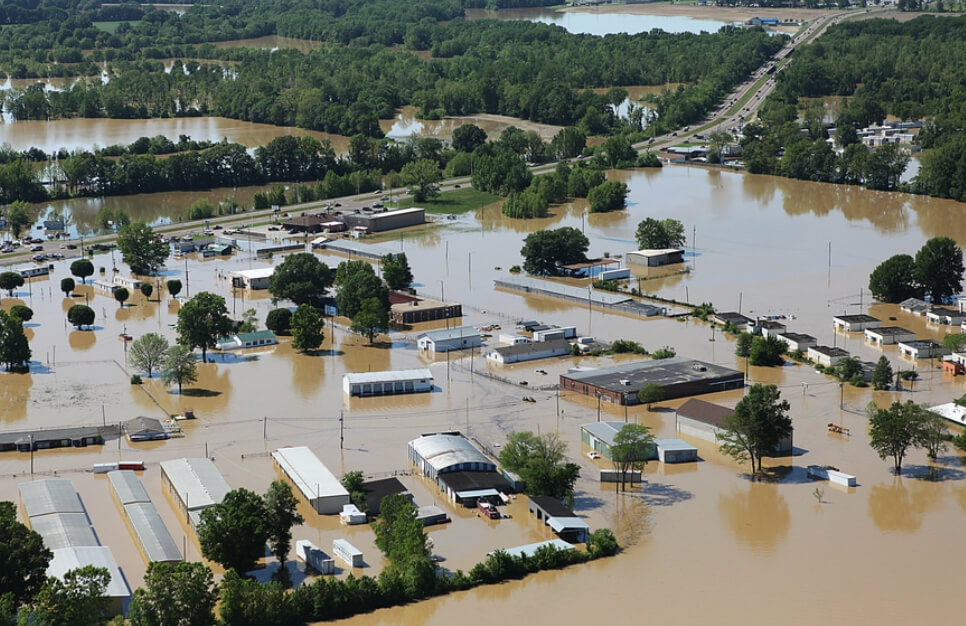
Two facts sit at the center of this topic and most buyers know neither.
First: standard homeowners insurance never covers flood damage. Not from a hurricane storm surge, not from a river, not from a flash flood that puts six inches through your ground floor. Flood requires a separate policy.
Second: a large share of flood claims come from properties outside designated high-risk zones — places where no lender required coverage and no one thought to buy it.
Climate risk has moved from an abstract concern to a line item on the closing statement. Here is what to check.
How flood zones work
FEMA maps properties into zones that determine whether coverage is federally required:
- Zones A and V — Special Flood Hazard Areas, roughly a 1% annual chance of flooding (the “100-year flood”). Federally backed mortgages require flood insurance here.
- Zones B, C and X — moderate to low risk. No federal requirement.
- Zone D — undetermined risk.
The critical caveat: “100-year flood” means a 1% chance each year, not once a century. Over a 30-year mortgage, that’s roughly a 26% cumulative probability — meaningfully higher than the odds of a house fire, which everyone insures against without hesitation.
FEMA maps also lag. They are updated periodically, do not fully capture urban drainage failures or intense rainfall events, and can be years behind development that changed how water moves through an area. A Zone X designation is not a guarantee of safety; it is a statement about a map.
What coverage costs and where to get it
NFIP (National Flood Insurance Program) policies are available in participating communities, with maximum coverage of $250,000 for the dwelling and $100,000 for contents on residential properties. Under Risk Rating 2.0, pricing now reflects individual property characteristics — distance to water, elevation, replacement cost, flood frequency — rather than broad zone-based pricing. That shift raised premiums substantially for some properties and lowered them for others.
Private flood insurance has expanded significantly and often offers higher limits, replacement cost on contents, additional living expenses coverage, and sometimes lower premiums for well-elevated properties. Lenders generally accept private policies that meet regulatory requirements. Get quotes from both.
Costs vary enormously — from a few hundred dollars a year in low-risk areas to many thousands in coastal high-risk zones. There is typically a 30-day waiting period before an NFIP policy takes effect, which is why buying it during a storm forecast doesn’t work. Buy at closing, not when weather is coming.
The elevation certificate
For properties in or near mapped flood zones, an elevation certificate documents the lowest floor’s elevation relative to the base flood elevation. It can dramatically change the premium, and can also support a Letter of Map Amendment (LOMA) application to have your property removed from a high-risk designation if the mapping is wrong about your specific parcel.
If a seller has one, get it. If not, one costs a few hundred dollars and can pay for itself in the first year.
The wider climate cost problem
Flood is the most visible risk but not the only one repricing property in 2026.
Wildfire has driven carriers to withdraw from parts of California, Colorado and other western states, pushing homeowners into state-backed insurers of last resort with narrower coverage and higher costs.
Wind and hail losses across the Plains and Midwest have driven percentage-based wind deductibles and roof-age underwriting into markets that never had them.
Insurance availability is now a purchase contingency issue. In high-risk markets, buyers are increasingly getting insurance quotes during the inspection period rather than assuming coverage will be available at an affordable price. A property that cannot be insured affordably cannot be financed, and cannot easily be resold.
What to check before you close
- Pull the FEMA flood map for the exact parcel, not the neighborhood.
- Get an actual flood quote — NFIP and private — before your contingency period expires.
- Ask for the seller’s claims history. A CLUE report shows insurance claims on the property over roughly the past seven years.
- Ask neighbors whether the street has flooded. Local memory is often more accurate than the map.
- Check elevation relative to nearby water and to the street; get the elevation certificate if one exists.
- Get a homeowners quote for the specific address early — not a national average estimate — since availability and cost vary house by house.
- Look at drainage and grading during the inspection. Where does water go when it rains hard?
Frequently asked questions
Does homeowners insurance ever cover flooding? No. Water damage from a burst internal pipe is typically covered; rising external water is not. The distinction is precise and it is where disputed claims concentrate.
Do I need flood insurance if I’m not in a flood zone? It isn’t required, but a substantial share of claims come from outside high-risk zones, and premiums in low-risk areas are comparatively cheap. For many buyers it is inexpensive protection against the loss most likely to be uninsured.
Does flood insurance cover the basement? Coverage for basements is limited under NFIP policies — structural elements and essential equipment are covered, but finished walls, flooring and most personal property in a basement generally are not.
Will climate risk affect my home’s value? Increasingly, yes — through insurance cost and availability rather than through buyer sentiment alone. A home that costs $9,000 a year to insure prices differently than an identical home costing $2,000.
Can I get flood insurance if my community isn’t in the NFIP? Not through the NFIP, but private carriers may write coverage. This is worth confirming before you commit to a purchase in such a community.
Conclusion
Insurance cost is no longer a footnote to the purchase decision — in high-risk markets it is one of the main variables. Get real quotes for the real address before your contingency period ends, and treat “the map says low risk” as one input rather than a conclusion.

Be First to Comment